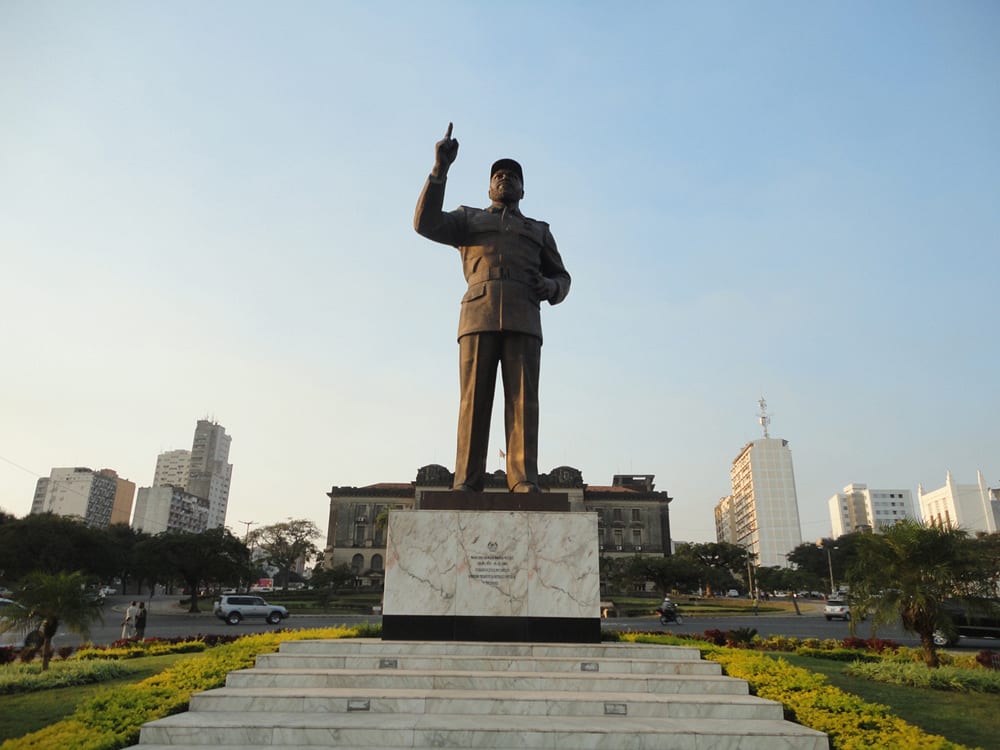
If you stand in the center of Maputo’s Independence Square (Praça da Independência), you cannot miss him. Towering over the plaza is a massive, 9-meter-bronze statue of a man in military fatigues, his arm confidently raised toward the sky. This is Samora Machel.
For travelers visiting Mozambique, his face, his name, and his legacy are inescapable. He is woven into the very fabric of the country’s identity. But who was this charismatic leader, and why does his memory still hold such power over the nation? Let’s explore the life of the first President of Mozambique and discover why he remains the ultimate symbol of the country’s freedom.
Who Was Samora Machel?
Born on October 29, 1933, in a rural village in Gaza Province, Samora Moisés Machel grew up witnessing the profound injustices of Portuguese colonial rule. Before he became a revolutionary, Machel studied nursing — one of the few professional fields open to Black Mozambicans at the time. Working in a hospital in Lourenço Marques (now Maputo), he protested the fact that Black nurses were paid significantly less than their white counterparts for the exact same work.
His anti-colonial ideals quickly led him into political activism. In 1963, Machel left Mozambique for Tanzania to join the newly formed liberation movement, FRELIMO. Recognizing his discipline and strategic mind, he was sent to Algeria for military training and quickly rose through the ranks to become FRELIMO’s top military commander. When FRELIMO’s founding president, Eduardo Mondlane, was assassinated in 1969, Samora Machel took the reins of the movement, leading the guerrilla army to victory and eventually declaring Mozambique’s independence in 1975.
Why Is He Considered a National Hero?
Samora Machel is revered among Mozambique’s heroes because he was more than just a military victor — he was a visionary who sought to completely transform society. He famously preached that to build a successful nation, the old colonial mindset had to die.
He pushed for absolute national unity, fiercely rejecting tribalism, racism, and regionalism. Machel envisioned a unified Mozambique where your identity as a citizen came before your ethnic group or social class. His charisma was electric, and his legendary slogan — “A Luta Continua!” (The Struggle Continues!) — became a rallying cry for freedom across the entire African continent.
What Were His Key Achievements?
As the country’s first president, Machel faced the monumental task of rebuilding a nation from scratch. Some of his most defining achievements included:
- Massive Education Campaigns — Under colonial rule, over 90% of the native population was illiterate. Machel nationalized education, built thousands of schools, and launched adult literacy programs, drastically reducing illiteracy rates within a single decade.
- Universal Healthcare — He nationalized medicine, creating a network of rural clinics to bring healthcare to the poorest citizens who had previously been entirely ignored by colonial infrastructure.
- Global Anti-Apartheid Leadership — Machel was a fierce internationalist. He turned Mozambique into a safe haven and operational base for freedom fighters fighting apartheid in South Africa and white-minority rule in Rhodesia (now Zimbabwe), sacrificing his country’s own economic stability to stand up for global human rights.
Tragically, his presidency was cut short. On October 19, 1986, Machel was returning from an international summit when his presidential plane mysteriously crashed into the Lebombo Mountains on the border of South Africa. To this day, many suspect the apartheid-era South African government was involved in his death, ensuring his status as a permanent martyr for African liberation.
Why Do So Many Places Bear His Name?
As you travel through the country, you will see the name “Samora Machel” on major avenues, schools, neighborhoods, and parks in nearly every city. This isn’t just about nostalgia — it is a deliberate act of national preservation. By naming the most prominent spaces after him, the post-independence government sought to anchor the values of courage, equality, and national pride into the daily lives of citizens. When you walk down Avenida Samora Machel, you are walking down a street dedicated to the very idea of Mozambican sovereignty.
How Do Mozambicans View Him Today?
Decades after his tragic death, Samora Machel is viewed with immense affection and respect, often remembered through a lens of profound nostalgia. While historians acknowledge that his Marxist economic policies faced severe challenges and his administration could be deeply authoritarian, everyday Mozambicans remember his absolute incorruptibility.
He is fondly recalled as a leader who genuinely loved his people, who walked the streets to inspect factories and schools himself, and who demanded the highest integrity from his government.
See the Legacy Firsthand with Nenane Tours
To truly understand the magnetic presence of Samora Machel, you need to stand beneath his shadow at Independence Square, look across at the City Hall, and see how his legacy directly faces the old colonial architecture. At Nenane Tours, we bring Samora Machel’s history to life. Our professional guides don’t just point out statues — we share the speeches, the triumphs, the secret histories, and the local anecdotes that help you feel the heartbeat of the revolution.